Fantasy Football Draft Strategy From The 1.08: Winning With A Late-Round QB
Chris Allen employs a winning fantasy football draft strategy selecting from the 1.08, utilizing a late-round QB approach.
My favorite part of cooking is going out to buy the ingredients. Or, in most cases, hunting through my fridge, pantry and (extensive) spice cabinet for what I need. There’s no pressure then. Only my ideas exist. But I have to make adjustments.
I’m not buying vanilla beans, hunting for Parmigiano-Reggiano, and I’m truly sorry for this, storing bay leaves in my kitchen. I know cheaper substitutes are available. Sure, the final product might be different, but I can plan for that before I start.
That’s drafting from the 1.08 in a nutshell. You’re starting more than halfway behind the rest of your league. It might feel like the odds already aren’t in your favor. But if you go in with the idea you’ll have weaker options at your disposal, you can tweak your strategy to account for the later draft slot.

Join Our Newsletter
Trusted by 400,000+ fantasy football players. Get access to Fantasy Life's free award winning newsletter and tools, all in one step.
By registering or logging in, you agree to our Terms of Use and Privacy Policy.
Tips From the 1.08 in Fantasy Drafts
Late-Round QB Doesn’t Mean … ANY Late-Round QB
Waiting until the later rounds to grab a QB isn’t my favorite strategy. Truth be told, I like the idea of having a monster like Josh Allen, Lamar Jackson, or Joe Burrow (you know I had to sneak my QB into the conversation) in my starter slot. While my opponent’s roster is accruing points, I can look at mine with an “at least I still have [insert player name] left to go” hopeful gaze. But, credit where it’s due, you late-round QB folks might be onto something.
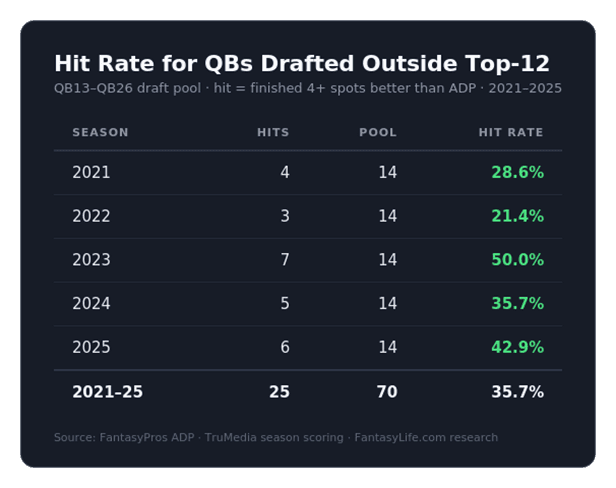
I calculated the hit rates for QBs with pre-draft ranks outside of the top 12 over the last five seasons. Two things stood out. One, we’ve gotten better as a community at finding values toward the backend of drafts. After multiple years with only three or four passers outkicking their ADP by at least four spots, the last three seasons have featured at least a third of the late-round pool creating value. Second, not just any QB with a triple-digit draft cost is worth a click.
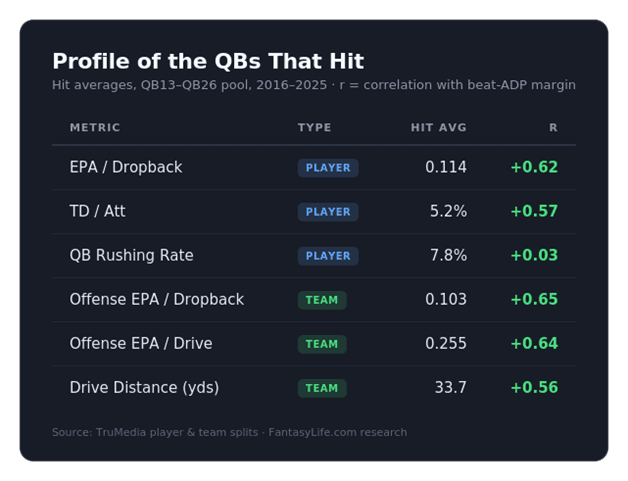
As I’ve walked through the anatomy of the overall WR1 and RB1, the concept of identifying not just good players, but positive ecosystems, comes into focus. It makes sense that we’d need both here to match or beat the value of an elite QB. However, seeing the drop in correlation for QB mobility was a surprise. Let’s reason it out together.
- RBs: Kenneth Walker (early-round), D'Andre Swift (early-round), Jordan Mason (late-round), Tyrone Tracy (late-round)
- WRs: Chris Olave, Terry McLaurin, Romeo Doubs, Jalen Coker
Look at the early-round WRs and RBs with ADPs similar to the elite signal-callers. Each projected for at least 12.0 PPR PPG or more. It puts the onus on the QBs to not only stay ahead of their peers, but make up for the receiver or rusher we’re giving up to draft them. That same bar lowers round by round as opportunity cost lessens. Of course, we’ll take any passer who leverages the Konami Code. But efficiency is the main driver in this stage of the draft.
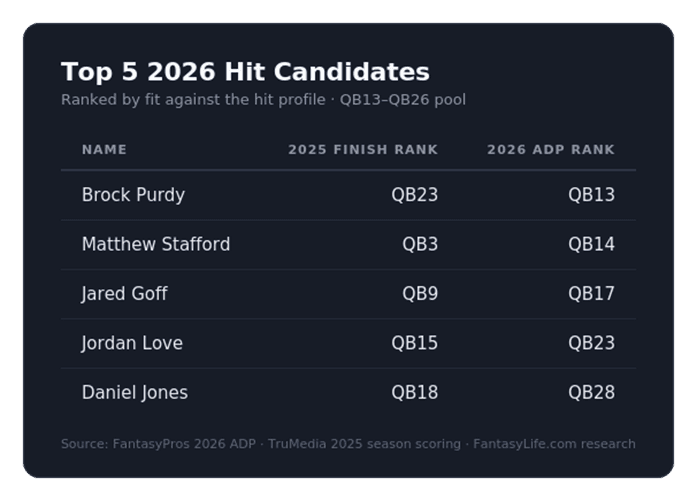
I used the profile metrics to highlight likely candidates for the upcoming season. The results embody the archetype we were just describing. Every offense featured in the list has at least three skill players with a top-100 ADP. In other words, we’re excited about the team. That hype should translate to the QB, but it may take the right environment to bring out their top-12 potential.
Now, let’s draft!
For reference, here’s the format I chose in the Draft Champion tool:
- 14 teams
- Standard
- 1QB, 2RBs, 3WRs, 1TE, 1FLEX, 1K, 1DST
You’re On the Clock at 1.08!
So, let’s set the stage for what to expect at eighth overall. I used standard scoring again, but the result is the same. The top-tier players at both positions will be gone. And the board will have you reconsidering joining the league.

However, without even saying this player’s name, let me see if I could get you interested in their profile.
- Rushing Attempt Share (Weeks 1-17): 72.0%
- Target Share: 9.0%
- Goal-line Carry Rate: 44%
Admittedly, we’re talking about a one-year sample. But only three other RBs ran the ball more often. Yes, that’s a meager target share. But this same guy was more efficient as a receiver than Jonathan Taylor. And he was right behind Bijan Robinson in carries from inside the 5-yard line (48%). Said another way, a workload comparable to the higher-price rushers is available at the 1.08. And when looking at the player, there’s no question about the talent.
James Cook had more explosive plays than Jahmyr Gibbs and more red-zone touches than Robinson. And Cook doesn’t come with the same environment concerns. Buffalo has matched or bested the trio of teams in EPA per play every season over the last three years. Josh Allen’s mobility is the first thing drafters point to as a negative for Cook. But Atlanta’s QB situation (or lack of clarity into it) hasn’t swayed Robinson managers. Regardless, Cook’s role and effectiveness in it set him up to be in the top-3 conversation by season’s end.
The Rest of the Early Rounds When Drafting From the 1.08
I bumped up the number of teams to test out my earlier thoughts on ADP as a function of league size. Twelve is my default. So, my expectations of who should be available in each round are the same. But even adding a couple of bots to the mix changed my thoughts on my second pick.
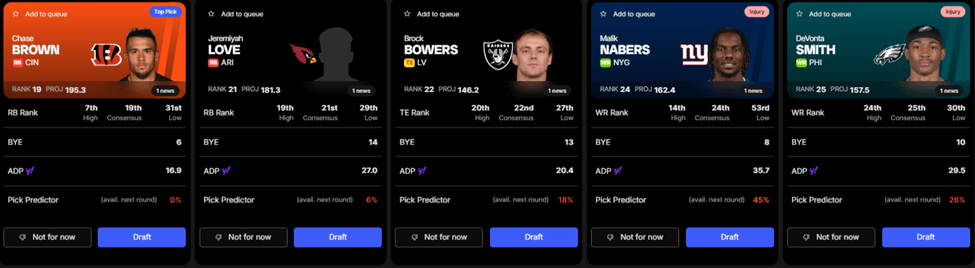
Over a week ago, Malik Nabers was a fourth-rounder. DeVonta Smith was a 2/3 turn guy. Now, they’re considerations toward the start of the second. However, I couldn’t pass up the top recommendation from the Draft Assistant.
- RBs (in standard scoring): 1.01 (points per reception), 0.63 (points per rush attempt)
- WRs: 1.77, 1.02
I used per-touch numbers from players across each position over the last 10 years to measure how much each reception or carry mattered. The ratio between rushing and receiving (for RBs, it’s dividing 1.01 by 0.63) for both positions works out to be nearly the same (~1.65). That result indicates RBs with a receiving skill set still have value. And Chase Brown’s talent in this field only seems to be improving.
- 2024: 50% (route rate), 11% (target share)
- 2025: 58%, 15%
However, look back at the starting roster requirements for this league. I need at least three WRs each week. Ignoring the position I have to have the most of is an uncomfortable situation. But, as I mentioned, our draft spot already put us there. Besides, our choices at 3.08 don’t inspire much confidence when it comes to filling our WR1 slot.
- Tee Higgins: 154.5 (projected points)
- Tetairoa McMillan: 147.7
- Emeka Egbuka: 156.4
- Luther Burden: 149.4
If we’re taking projections as gospel, nobody stands out. Our end-of-season expectations seem to flatten out in this portion of the draft. When this happens, it’s time to weigh other positions.
- Brock Bowers: 146.2
- Colston Loveland: 137.4
- Trey McBride: 133.1
- Tyler Warren: 120.1
- Tucker Kraft: 109.9
Look at the drop-off after McBride. The casual glide down of 7-8 points sharpens to double digits after a single player. So, now that I’ve identified a tier break, while also noting I can find analogous receivers later, we can leverage our later draft slot into a formidable roster coming out of the early rounds.
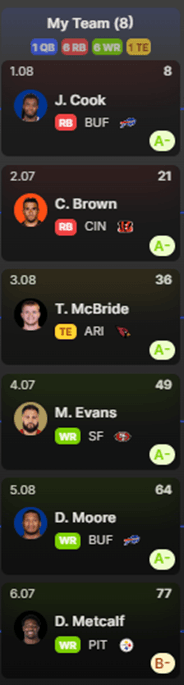
Each WR has the requisite workload to lead their team in scoring. Meanwhile, my squad opens with RBs and a TE I wouldn’t bench outside of their bye weeks. However, there’s an obvious flaw I’d have to address in the middle rounds.
Mid-Round Pitfalls at the 1.08
Let’s start in the seventh round as we always do. Take a look at the team. Call out the weaknesses.
- Need a QB
- Need RB depth
- Need WR depth
We’ve got starters but nobody to call up if our preseason notions turn out to be wrong. More importantly, we’re careening toward employing the late-round QB strategy we discussed earlier. By the 7.08, 11 QBs were off the board. And with 12 picks between me and my next selection, it was time to make a stand.
I’m pretty sure I saw Purdy’s name in a table earlier. It was the one using the combination of historical passer and team efficiency metrics to call out QBs with the potential to exceed their draft cost. Sure, we could’ve waited in the hopes one of the others would still be available. There are even a couple of guys later with comparable potential (e.g, Jared Goff, Baker Mayfield). However, if we’re trying to overcome our weaker draft slot, being aggressive in this situation has its merits.
Building a Championship Fantasy Football Roster From the 1.08
I’ve said it before, and I’ll say it again. We’re not here to “win” our draft. Your team could get an A+ grade in August and flame out by October. This series and using the simulation tool is to help you find the tools to work through how to handle less-than-desirable circumstances. Drafting from the eight spot is a prime example. However, with the process we’ve laid out, you have a better understanding of how to flip the case in your favor.
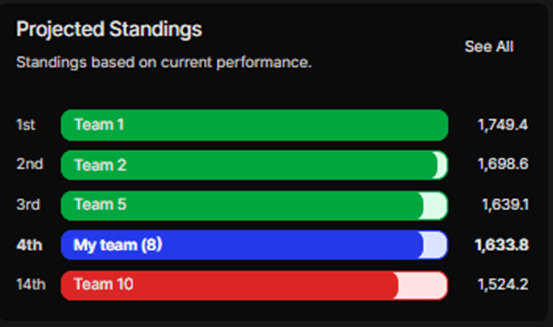
Let’s look at the full squad.

Could you have taken Lamar Jackson instead of McBride and figured out TE in the middle rounds? Absolutely. Tucker Kraft (6.08) or Sam LaPorta (7.05) are viable tradeoffs.
Will you need some luck at RB? Without question. But everyone on the bench has contingent upside should their backfield condense around them.
In short, the common pushback for mock drafts is they don’t reflect reality. This result would “never” happen in your league. But by prioritizing tiers and archetypes, the names can change without the range of outcomes diminishing.

Unlock Our Tools!
Stop hitting the paywall. FL+ gives you access to our premium in-depth content, expert rankings & projections, mock draft simulator, and all the tools you need – all personalized to your league.
Players Mentioned in this Article
 JamesCookRBBUF
 BrockPurdyQBSF
- PPG
- 18.8
- Proj
- 301.5
 ChaseBrownRBCIN
 LamarJacksonQBBAL
- PPG
- 16.3
- Proj
- 332.8
Published Updated